Thermal Management Die Cut Components: Materials and Applications
Abstract
Thermal management is becoming a core design issue for AI servers, EV batteries, power electronics, telecom equipment and compact consumer devices. As products become thinner, hotter and more densely packed, engineers need materials that can transfer heat, spread heat, insulate sensitive areas and maintain stable contact under real assembly conditions. Die cut thermal interface material, graphite heat spreaders, thermal pads, thermal tapes, insulation films and thermal insulation pads are used to solve these interface-level problems. This guide explains the thermal pain points, material choices, die cutting design rules, application scenarios, quality inspection and RFQ points for custom thermal management components.
Thermal Management Pain Points in AI Servers and EV Systems
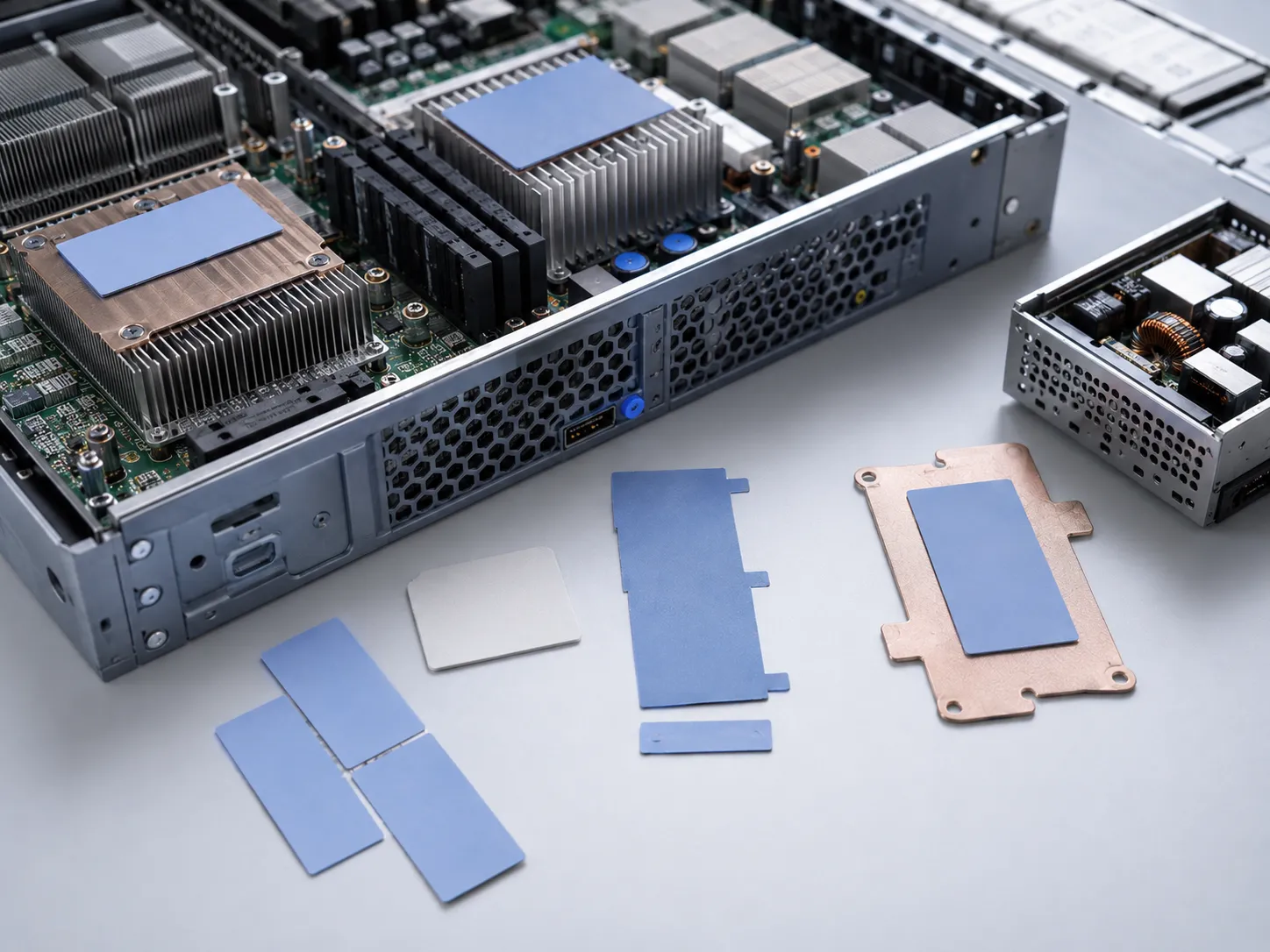
Thermal design is no longer just about adding a heat sink. In AI servers, high-power processors, GPUs, memory modules and power devices create intense local heat. The International Energy Agency reports that global data centre electricity consumption is projected to double to around 945 TWh by 2030, with AI-focused data centres growing much faster than overall data centre electricity use.
In EV batteries, thermal systems help keep battery packs within an optimal temperature range, especially under harsh operating conditions. NHTSA notes that battery thermal management helps maintain pack temperature, but it also consumes part of the vehicle’s energy.
For engineers, the difficult part is the interface. Heat must move across uneven surfaces, small gaps, metal housings, plastic structures and insulated areas. If the thermal material is too hard, too thick, poorly compressed or inaccurately cut, the whole thermal path becomes less reliable.
What Are Thermal Management Die Cut Components?
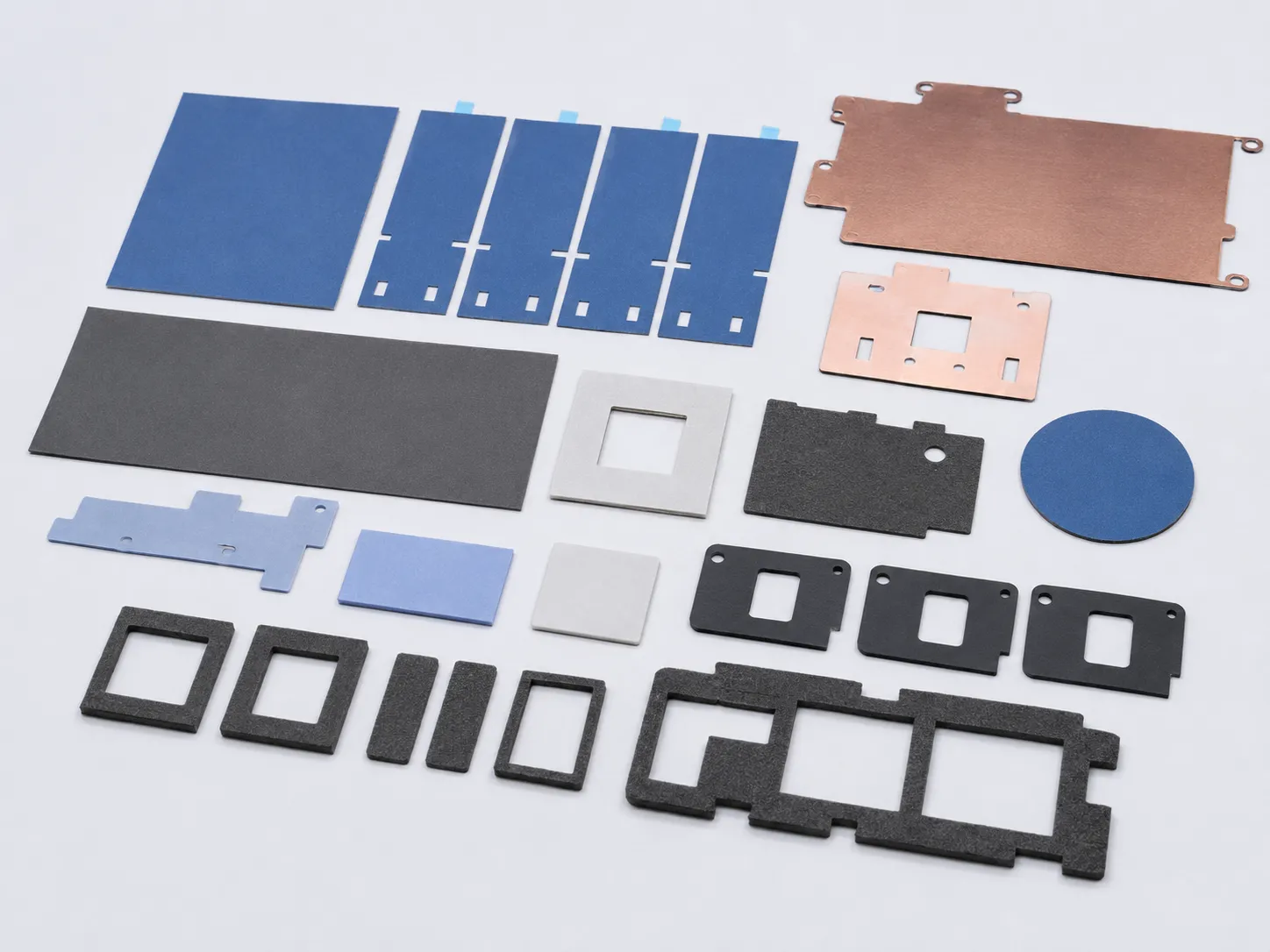
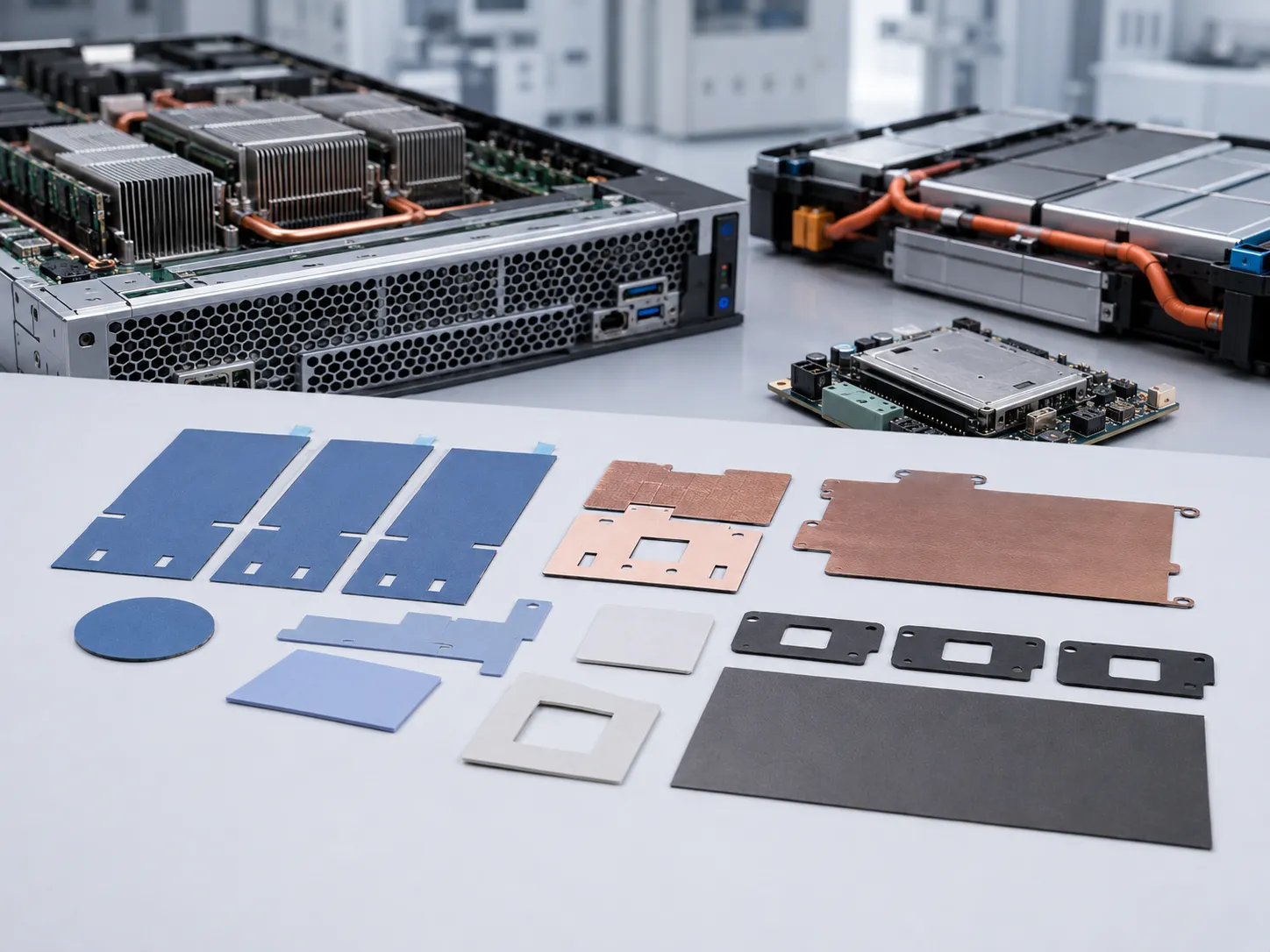
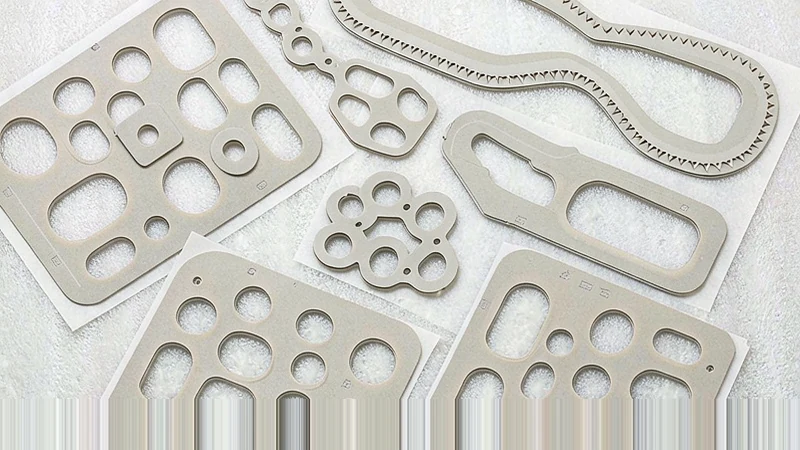
Thermal management die cut components are custom-shaped parts made from thermal interface materials, graphite sheets, thermal tapes, insulation films, thermally conductive pads and heat insulation materials. They are cut to match specific component shapes, holes, slots, connector areas and mounting positions.
Component Type | Main Function | Typical Use |
Thermal pad | Fill gaps and transfer heat | Power modules, heat sinks, battery packs |
Graphite heat spreader | Spread heat laterally | Phones, tablets, AI modules, compact electronics |
Thermal tape | Bond and transfer heat | Small heat sinks, LED modules, PCB assemblies |
Thermal insulation pad | Slow unwanted heat transfer | EV batteries, industrial electronics |
PI / PET insulation film | Electrical isolation | PCB, power supplies, battery modules |
Composite thermal part | Combine heat transfer, bonding and insulation | High-density assemblies |
The value of die cutting is not only shape accuracy. It allows the thermal part to fit the assembly, avoid interference, support clean installation and maintain repeatable contact pressure.
How to Choose Die Cut Thermal Interface Material?
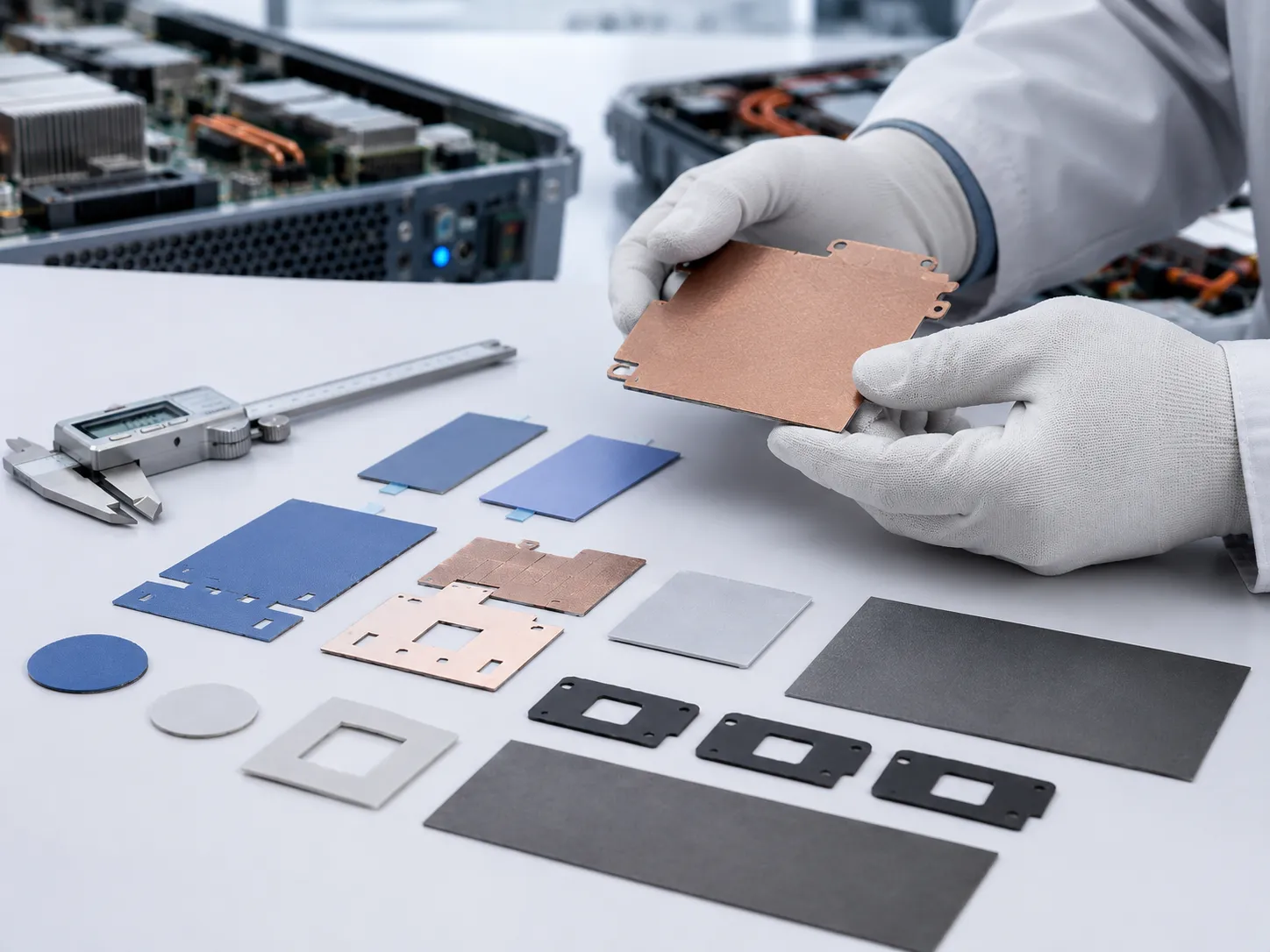
A die cut thermal interface material is used between a heat source and a heat sink, metal frame, cooling plate or housing. Its job is to reduce air gaps and improve contact between two surfaces.
Key Selection Parameters
When choosing a die cut thermal interface material, engineers should review:
① Thermal conductivity
② Material thickness
③ Compressed thickness
④ Hardness and conformability
⑤ Electrical insulation requirement
⑥ Surface tack or adhesive structure
⑦ Operating temperature range
⑧ Long-term aging and compression stability
Higher thermal conductivity is not always better if the material cannot compress properly. A softer pad with stable contact may perform better than a high-conductivity material that leaves micro-gaps after assembly.
Graphite Heat Spreaders, Thermal Pads and Thermal Tapes
Different thermal materials solve different heat problems.
Material | Best At | Limitation |
Thermal pad | Vertical heat transfer and gap filling | Thickness and compression must be controlled |
Graphite heat spreader | Lateral heat spreading in thin spaces | Edge protection and insulation may be needed |
Thermal tape | Bonding plus heat transfer | Not ideal for large gap compensation |
Thermal insulation pad | Heat blocking and safety separation | Does not replace heat transfer materials |
Thermally conductive film | Heat transfer plus insulation | Must balance dielectric strength and conductivity |
Open Compute Project’s cooling work focuses on areas such as cold plates, coolant distribution units, immersion, door heat exchangers and heat reuse, showing how thermal architecture is becoming more complex in data center hardware. For die cut suppliers, this means thermal parts must support more precise shapes, thinner spaces and more demanding contact designs.
Die Cutting Design for Thermal Interface Materials
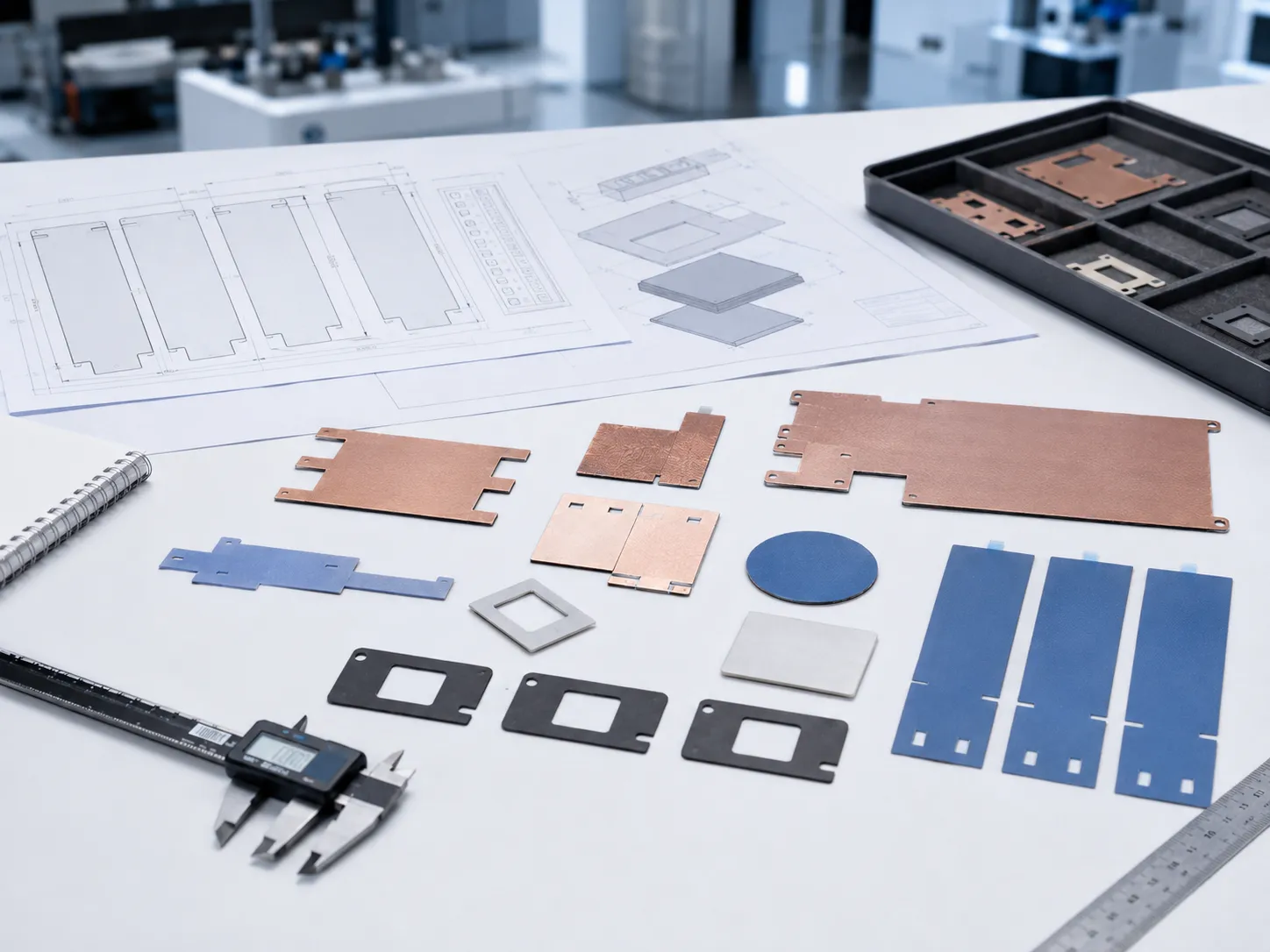
Thermal parts often fail because of design details, not because the base material is wrong. A good die cutting design should consider how the part is installed, compressed and inspected.
Design Points Engineers Should Confirm
Design Item | Why It Matters |
Hole position | Avoids interference with screws and standoffs |
Edge clearance | Prevents material overflow or short-circuit risk |
Liner structure | Improves handling and assembly efficiency |
Pull tab | Helps operators remove liners cleanly |
Thickness tolerance | Affects thermal contact and mechanical stack-up |
Compression area | Determines whether heat transfer remains stable |
Packaging format | Supports manual or automated assembly |
For small thermal pads and graphite pieces, stable waste removal and edge control are also important. Graphite can be fragile at narrow bridges or sharp corners, while soft thermal pads may deform if the tool design is not suitable.
Applications of Thermal Management Die Cut Components
AI Servers and Data Center Hardware
AI servers use thermal pads, graphite sheets, insulation films and EMI-related conductive parts around GPUs, CPUs, accelerators, memory, power modules and high-speed boards. A custom thermal pad may fill the gap between a processor package and heat sink. A graphite heat spreader may distribute localized heat across a larger surface.
EV Batteries and Energy Storage
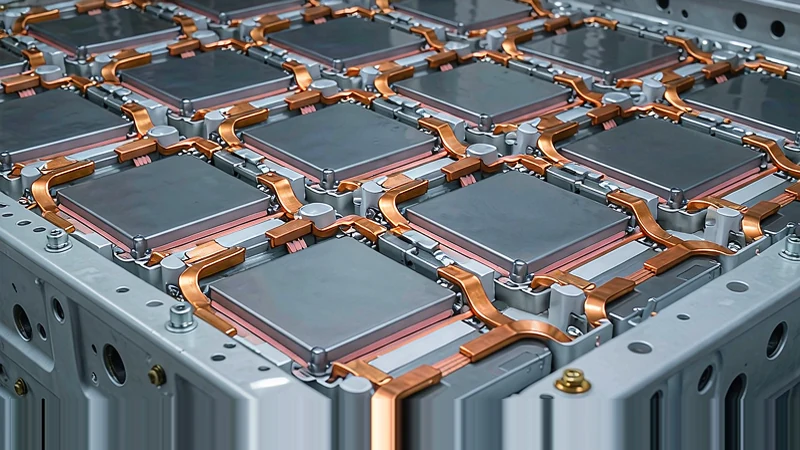
Battery packs require both heat transfer and heat blocking. Thermal pads help transfer heat to cooling plates, while thermal insulation pads help slow unwanted heat movement between areas. Insulation films may also be needed to prevent electrical contact.
Consumer Electronics and Wearables
Phones, tablets, cameras, smart locks and wearable devices need thin thermal components that fit limited spaces. Graphite sheets, thermal tapes and protective insulation films are common because they are thin and can be cut into complex shapes.
Industrial Control and Telecom Equipment
Industrial control systems and telecom modules often run continuously in enclosed spaces. Die cut thermal interface material can support power supply modules, communication boards, metal housings and compact heat sinks.
Quality Inspection for Thermal Die Cut Parts
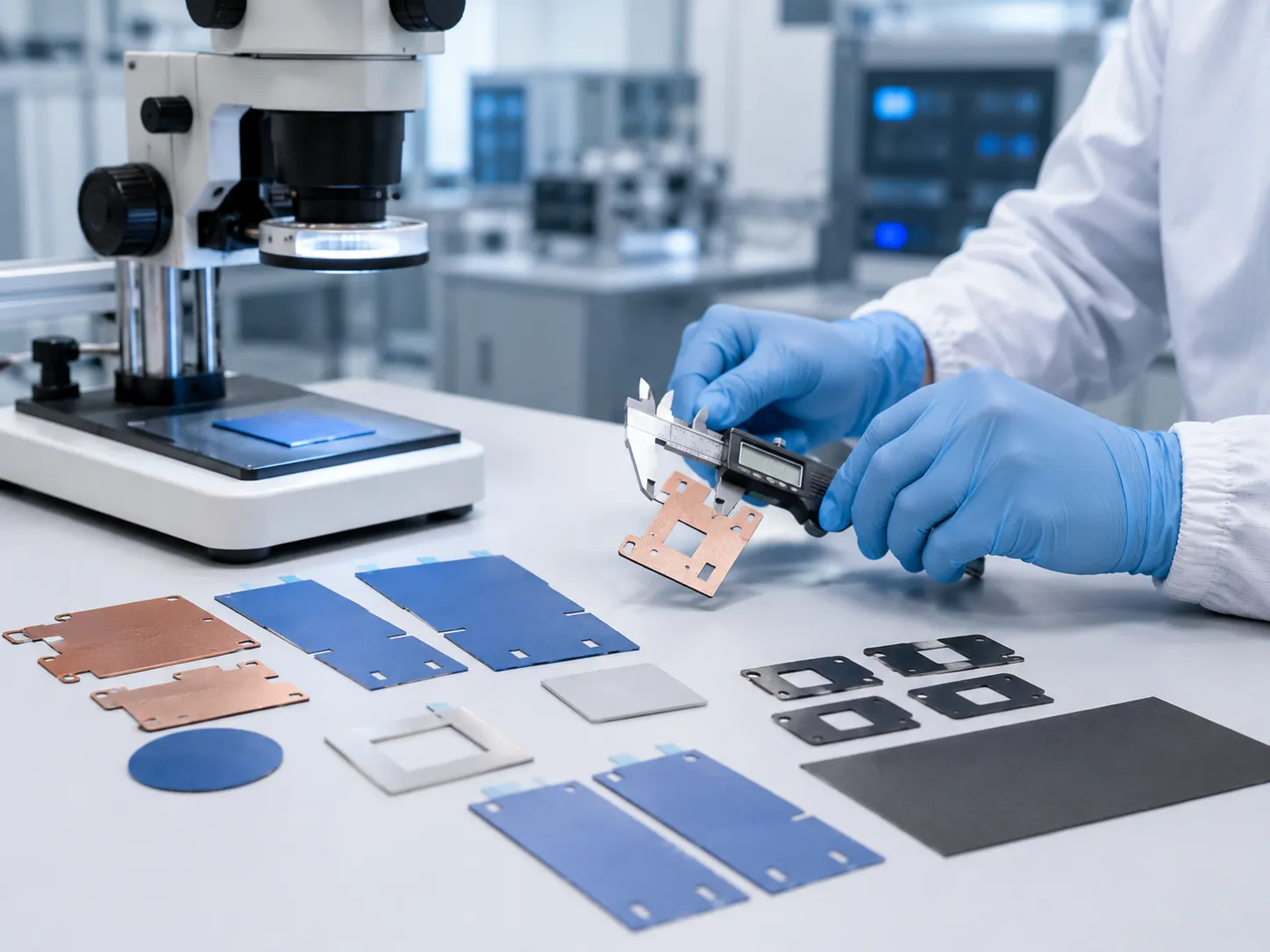
Quality control should focus on both shape and function.
Inspection Area | What to Check |
Dimension | Length, width, holes, slots, edge accuracy |
Thickness | Nominal and compressed thickness if required |
Appearance | Edge damage, contamination, wrinkles, cracks |
Adhesive | Peel condition, liner release, overflow |
Material lot | Traceability and batch consistency |
Packaging | Sheets, rolls, trays, bags or liner-backed parts |
For precision projects, inspection may include first article inspection, in-process checks, outgoing inspection, CCD inspection and measurement reports. Xinyusheng’s company profile lists IQC incoming inspection, first article confirmation, IPQC patrol inspection, QC inspection and QA outgoing inspection as part of product quality control.
How Xinyusheng Supports Custom Thermal Pads and Heat Management Parts?
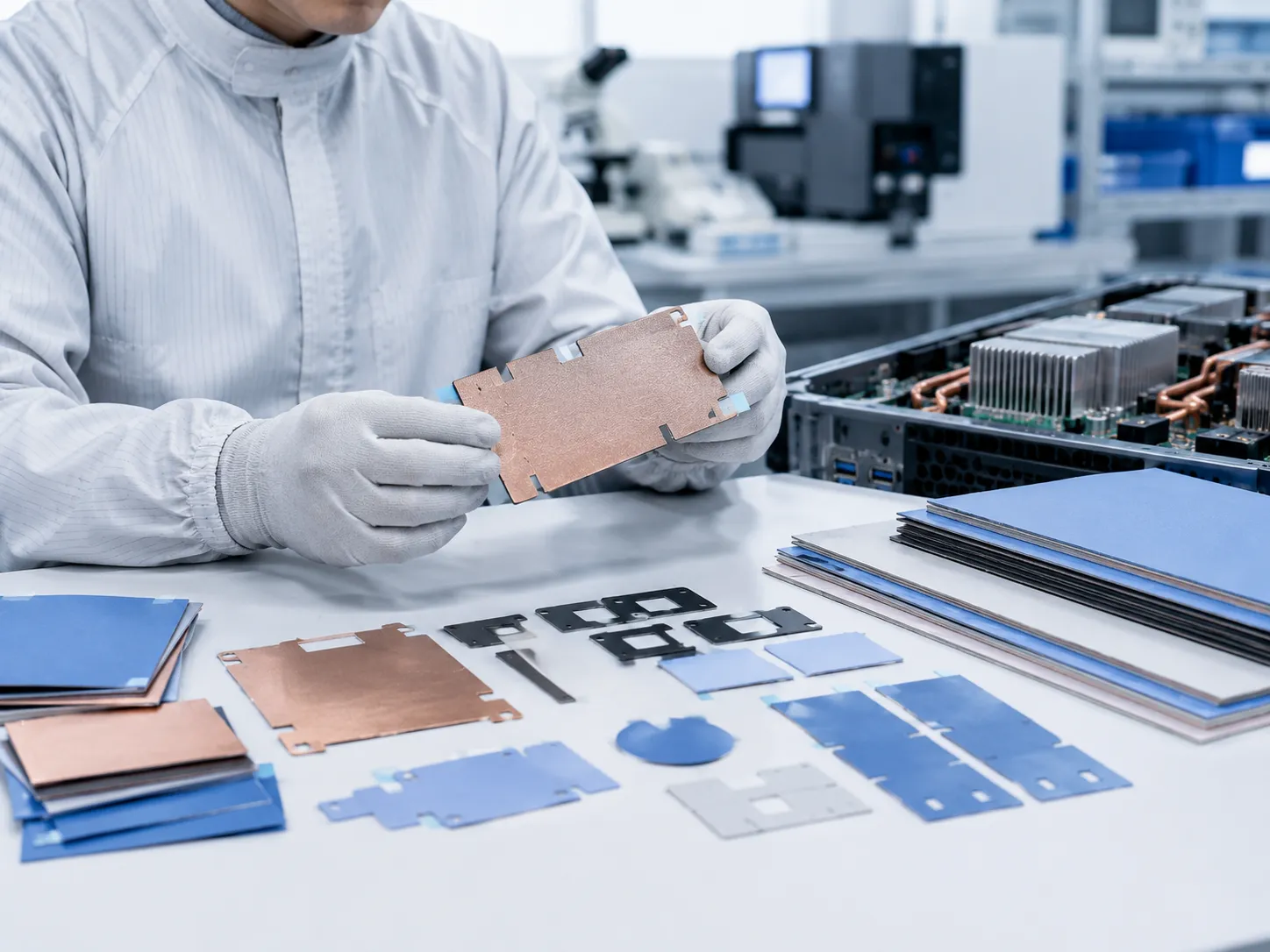
Xinyusheng supports custom precision die cutting for functional components used in consumer electronics, automotive electronics, new energy, medical devices, communication equipment and printed products. Its company profile lists thermal products among the main product categories, alongside waterproof, tape, foam, insulation, light-blocking, conductive, mesh, protective film and printing products.
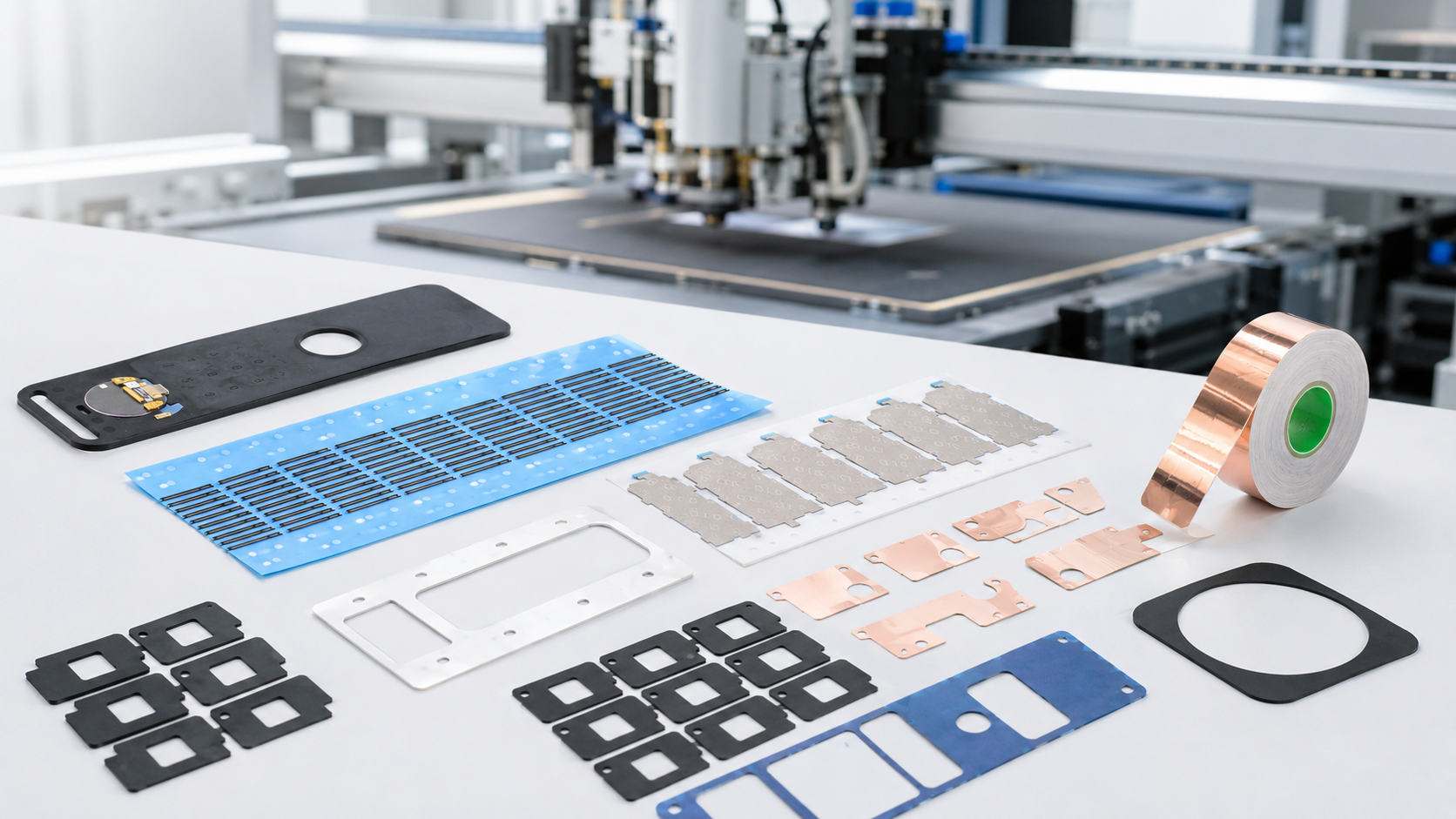
For thermal management projects, Xinyusheng can support material review, sample development, lamination, die cutting, inspection and mass production. The SEO plan also identifies die cut thermal interface material as a core product keyword for the Thermal Management Series, and recommends using resource articles to connect product pages, material pages and application pages.
This support is useful when one part must combine heat transfer, insulation, adhesive backing, liner design and tight assembly tolerance. Instead of treating a thermal pad as a simple rectangle, the part should be reviewed as a functional interface inside the final device.
FAQ
What is a die cut thermal interface material?
A die cut thermal interface material is a custom-shaped thermal pad, tape, graphite sheet or conductive film used to fill gaps and transfer heat between electronic components and cooling structures.
What is the difference between a thermal pad and a graphite heat spreader?
A thermal pad usually transfers heat through thickness and fills gaps. A graphite heat spreader mainly spreads heat across a thin surface area. Some assemblies use both.
Can thermal materials also provide electrical insulation?
Yes. Some thermally conductive films and pads are designed to transfer heat while providing electrical insulation. Engineers should confirm dielectric strength, thickness and operating voltage.
What information is needed for a thermal die cutting quote?
Provide drawings, material target, thickness, tolerance, application, heat source, cooling surface, compression condition, adhesive requirement, quantity and inspection standard.
Where are thermal management die cut components used?
They are used in AI servers, EV batteries, energy storage, telecom equipment, industrial control systems, consumer electronics, medical devices and smart hardware.
Source References
① Xinyusheng KPI keyword table: thermal interface and thermal management keyword selection.
② Xinyusheng SEO plan and company profile: product categories, quality control flow and internal linking direction.
③ IEA Energy and AI: data centre electricity demand growth.
④ Open Compute Project Cooling Environments: cold plate, CDU, immersion and data center cooling areas.
⑤ NHTSA electric and hybrid vehicle safety reference: battery thermal management role.
Table of Contents
Related news
Company News
What Is Custom Precision Die Cutting? What Types of Custom Functional Components Is Xinyusheng Suitable For?
May 14,2026
Discover More
Company News
How Are Die Cut Materials Used in Automotive Electronics?
August 29,2026
Discover More
Company News
What Types of Thermal Interface Materials Can Be Die Cut?
August 29,2026
Discover More
