Thermal Pad vs Graphite Heat Spreader vs Thermal Tape: How to Choose
Summary
Choosing between a thermal pad, graphite heat spreader and thermal tape depends on the heat path, component structure, available space, assembly method and long-term reliability requirements.
A thermal pad is usually used to fill gaps and transfer heat through thickness. A graphite heat spreader is better for spreading heat across a thin surface. Thermal
tape is suitable when heat transfer and bonding are required at the same time.
For AI servers, consumer electronics, EV batteries and telecom equipment, the right die cut thermal interface material is not selected by thermal conductivity alone. Engineers also need to evaluate thickness, compression, insulation, adhesive strength, thermal resistance, die-cut tolerance and mass-production consistency.
What Are Die Cut Thermal Interface Materials?
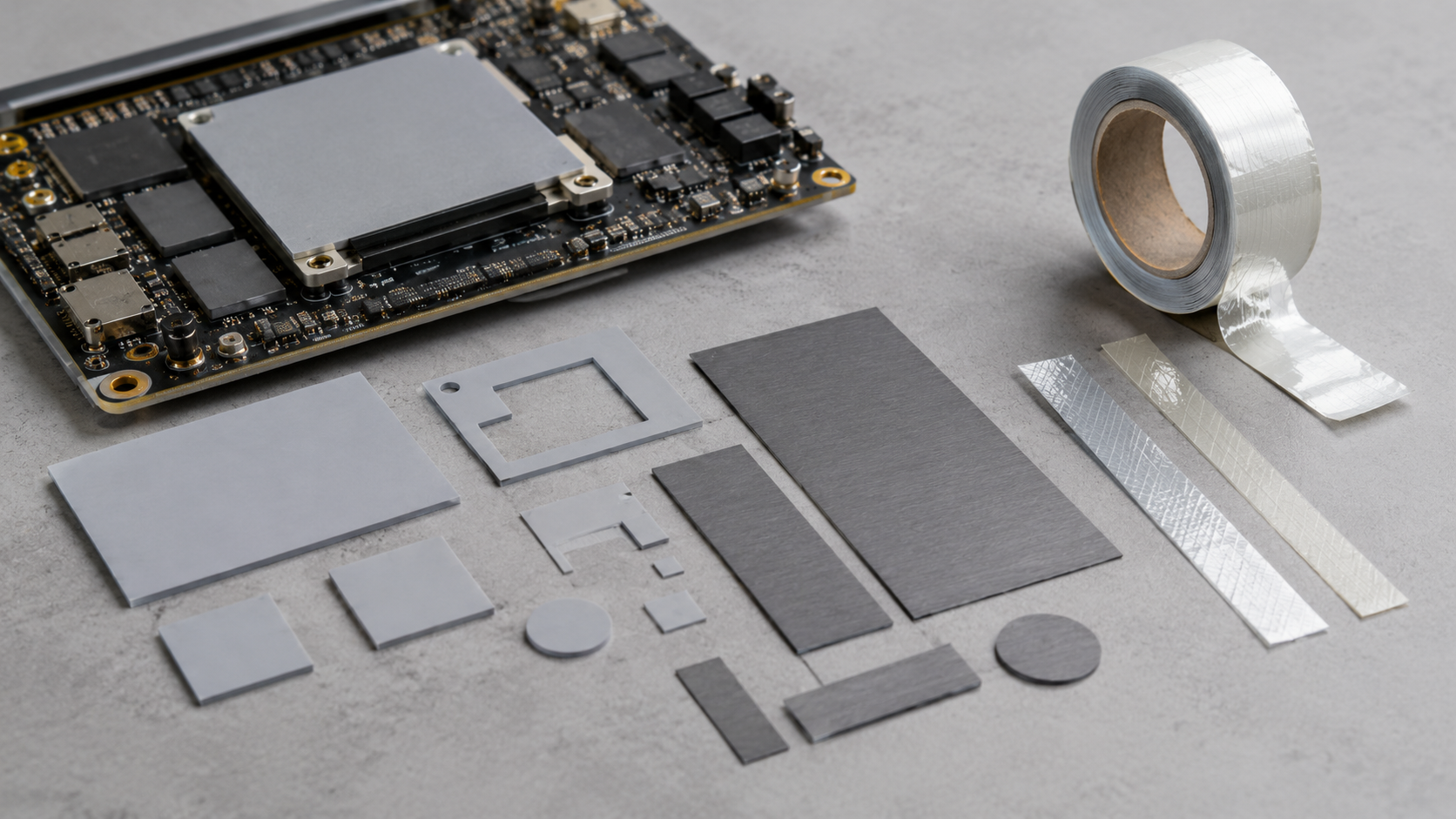
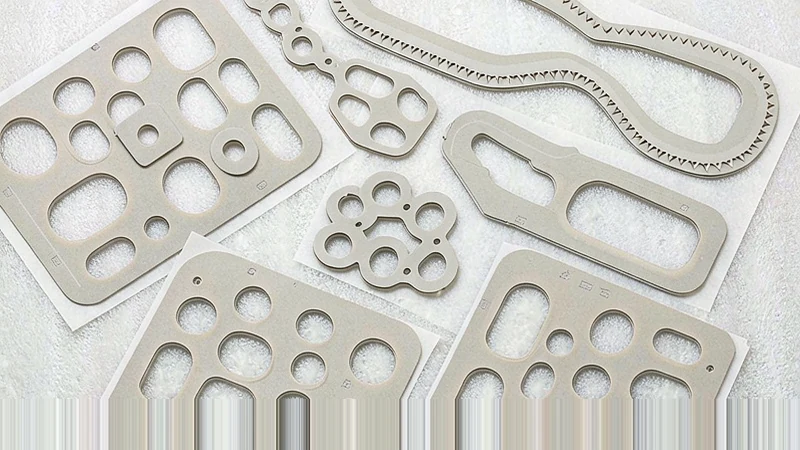
Die cut thermal interface material refers to thermal pads, graphite sheets, thermal tapes, thermal films and composite materials that are converted into custom shapes for specific thermal management positions.
These materials are usually placed between a heat source and a heat sink, housing, cold plate, metal frame, battery module or other cooling structure. Their main purpose is to reduce air gaps, improve surface contact and help heat move away from sensitive electronic components.
Why Thermal Interfaces Matter in Compact Electronics?
Thermal interface materials matter because real surfaces are never perfectly flat. Even small air gaps between a chip, battery cell, power module or housing can increase thermal resistance and reduce cooling efficiency.
A properly designed thermal interface material can fill these microscopic gaps, improve contact and create a more stable heat transfer path.
This is especially important in high-power and compact devices, such as AI servers, smartphones, EV battery packs, telecom modules, power supplies, routers, base stations and industrial control equipment.
Why Die Cutting Is Important?
Die cutting makes thermal materials easier to assemble and more suitable for mass production.
Through precision die cutting, thermal pads, graphite sheets and thermal tapes can be made into custom shapes with holes, tabs, release liners, positioning structures and multilayer laminations. This helps improve assembly speed, reduce manual errors and ensure consistent product quality.
For custom electronic products, thermal interface die cutting is often not just a material process. It is part of the overall thermal, mechanical and assembly design.
Thermal Pad vs Graphite Heat Spreader vs Thermal Tape: Key Differences
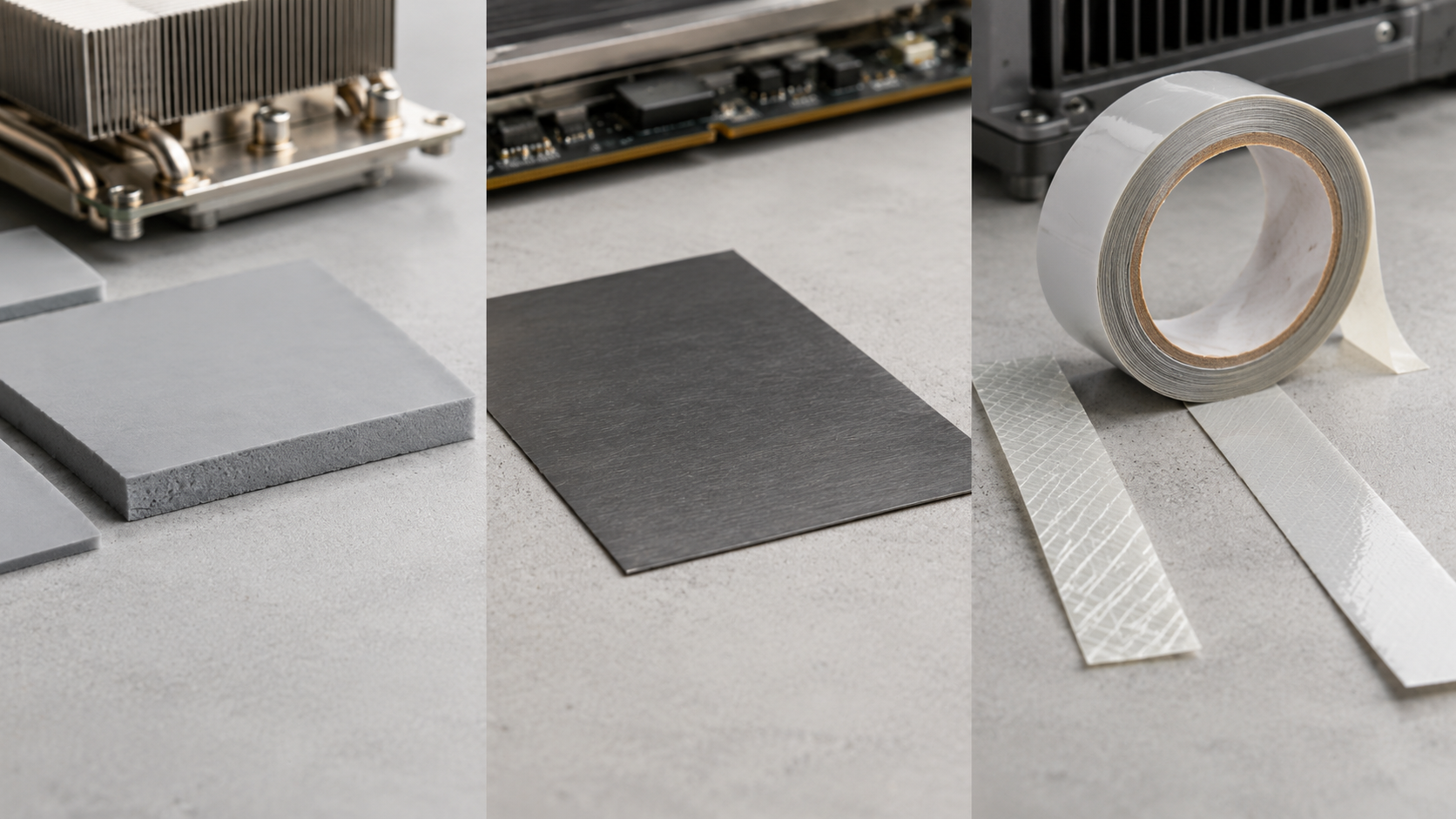
The main difference is that a thermal pad fills vertical gaps, a graphite heat spreader spreads heat laterally, and thermal tape bonds components while providing moderate heat transfer.
Material | Main Function | Key Advantage | Limitation | Common Applications |
Thermal Pad | Gap filling and through-thickness heat transfer | Soft, compressible and stable contact | Requires suitable compression space | Power modules, AI servers, batteries, controllers |
Graphite Heat Spreader | In-plane heat spreading | Ultra-thin, lightweight and high lateral heat transfer | May need insulation or edge protection | Smartphones, tablets, wearables, compact electronics |
Thermal Tape | Bonding and heat transfer | Adhesive, easy assembly and no mechanical fastener needed | Limited gap filling ability | Sensors, LED modules, small heat sinks, internal bonding |
Thermal Pad for Gap Filling and Compression
A thermal pad is the better choice when there is a visible or uneven gap between the heat source and the cooling structure.
Thermal pads are soft and compressible. They can compensate for mechanical tolerance, absorb slight surface unevenness and maintain contact during vibration, thermal cycling or long-term operation.
They are commonly used in power electronics, battery modules, AI server boards, industrial control equipment and telecom devices.
For custom die cut thermal pads, important specifications include thickness, hardness, compression ratio, thermal conductivity, dielectric strength, surface tack, operating temperature and release liner design.
Graphite Heat Spreader for Thin In-Plane Heat Spreading
A graphite heat spreader is better when the design needs to move heat across a very thin surface.
Unlike a thermal pad, graphite does not mainly fill a large gap. Its main value is lateral heat spreading. It can distribute localized hotspots over a larger area and help the device shell, frame or cooling structure dissipate heat more evenly.
Graphite heat spreaders are widely used in smartphones, tablets, VR devices, wearable electronics, wireless charging modules and other space-limited consumer electronics.
In practical production, graphite sheets can be laminated with PET, PI, adhesive, foam, insulation film or protective layers to improve handling, insulation and assembly reliability.
Thermal Tape for Bonding and Heat Transfer
Thermal tape is suitable when a component needs to be fixed in place while also transferring heat.
Compared with screws, clips or liquid adhesives, thermal tape can simplify assembly and reduce structural complexity. It is commonly used to attach small heat sinks, bond modules, fix sensors, mount LED strips and secure internal components.
However, thermal tape usually has weaker gap-filling ability than a compressible thermal pad. It works better when the bonding surfaces are relatively flat and the gap is very small.
How to Choose Thermal Pad Die Cutting for Your Application?
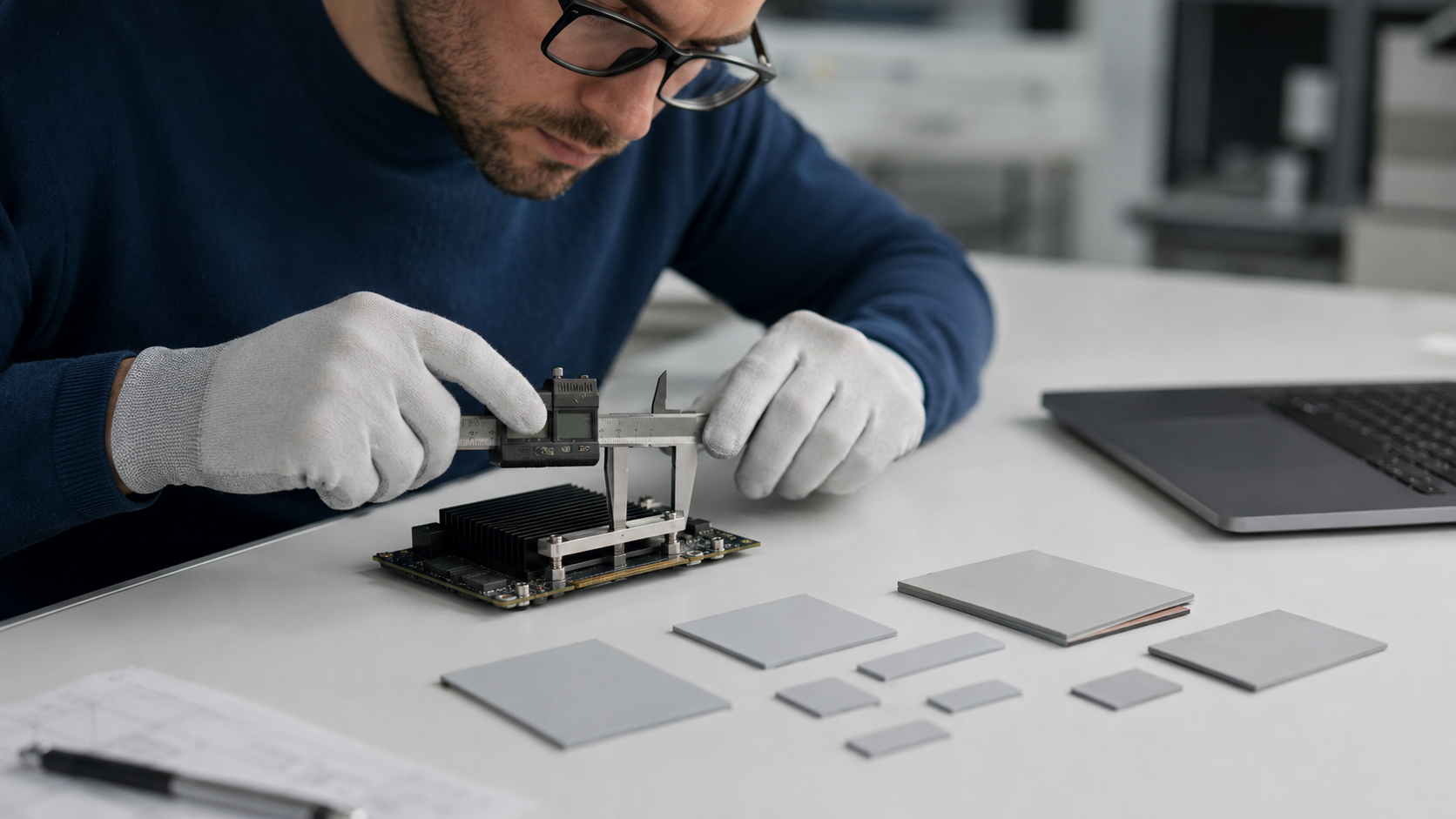
The best material should be selected according to the actual heat path, not only by comparing thermal conductivity numbers.
A material with high conductivity may still perform poorly if it cannot fit the gap, contact the surface properly or survive the assembly and operating conditions.
Step 1: Confirm the Heat Transfer Direction
The first question is: where does the heat need to go?
If heat needs to move vertically from a chip to a heat sink, from a power device to a housing, or from a battery cell to a cooling plate, a thermal pad is often a suitable choice.
If heat needs to spread horizontally across a thin area, a graphite heat spreader may be more effective.
If heat transfer and bonding are both required, thermal tape should be considered.
Step 2: Check Gap Size and Compression
Gap size is one of the most important factors in thermal material selection.
For larger or uneven gaps, a compressible thermal pad is usually better. It can adapt to height differences and maintain stable contact.
For very thin spaces, graphite sheets or thermal tapes may be more suitable. These materials can provide thermal support without taking too much internal space.
Step 3: Compare Thickness, Conductivity and Thermal Resistance
Thermal conductivity is important, but thermal resistance is often more directly related to actual performance.
A thicker material may increase thermal resistance, even if its conductivity is high. A thinner material may perform better only when it can fully contact both surfaces.
Therefore, engineers should compare material thickness, compression condition, actual contact area and heat flow direction together.
Step 4: Evaluate Electrical Insulation
Electrical insulation is critical in EV batteries, power electronics, high-density PCBs and telecom equipment.
Some materials are naturally insulating, while graphite and metal-based materials may need additional insulation layers. If the thermal material is close to circuits, busbars, battery cells or metal housings, the insulation requirement should be confirmed at the early design stage.
Step 5: Consider Adhesive and Assembly Method
Adhesive design affects both assembly efficiency and long-term reliability.
Some thermal pads need single-sided adhesive for positioning. Graphite sheets may need adhesive backing or protective lamination. Thermal tapes rely on adhesive strength as one of their core functions.
For automatic assembly or large-volume production, die-cut release liners, pull tabs, roll format and positioning holes should also be considered.
Application Guide: AI Server, Consumer Electronics, EV Battery and Telecom
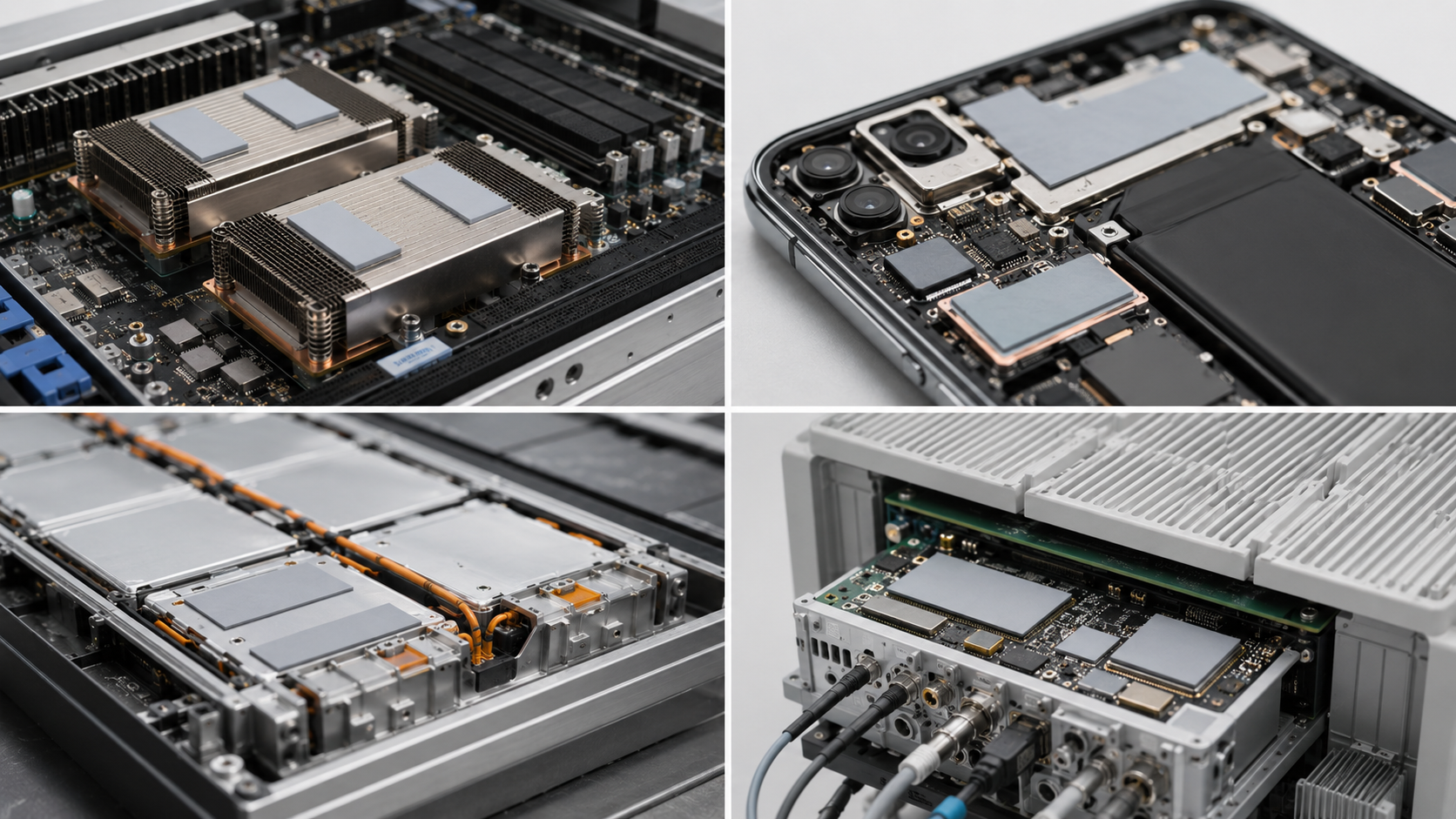
Different industries need different thermal material solutions because their heat sources, structures and reliability requirements are different.
Application | Main Thermal Challenge | Recommended Material Direction |
AI Server | High power density, dense boards, stable long-term cooling | Thermal pads, graphite sheets, insulation films |
Consumer Electronics | Thin structure, local hotspots, limited space | Graphite heat spreaders, thin thermal tape, small thermal pads |
EV Battery | Cell temperature uniformity, vibration, long-term reliability | EV battery thermal pads, gap fillers, insulation films |
Telecom Equipment | Outdoor operation, power modules, enclosure heat transfer | Thermal pads, thermal tapes, graphite or composite spreaders |
AI Server Thermal Interface Material
AI servers create strong demand for AI server thermal interface material because CPUs, GPUs, memory modules and power systems generate high heat in a compact structure.
Thermal pads can fill gaps between hot components and heat sinks, cold plates or metal frames. Graphite heat spreaders can help distribute localized hotspots in limited board space. Thermal tape can be used for bonding smaller internal modules where moderate heat transfer is required.
In AI server applications, engineers should pay special attention to compression stability, operating temperature, insulation, flame resistance and long-term reliability.
Consumer Electronics Thermal Management
Consumer electronics usually require thin, lightweight and highly customized thermal components.
Smartphones, tablets, VR devices, smart wearables and wireless charging products often use graphite heat spreaders because graphite can spread heat across a thin surface without adding much thickness.
Thermal pads may be used in areas where components need to contact a frame, shield or small cooling structure. Thermal tape can support bonding for sensors, covers, internal brackets or small modules.
For consumer electronics, precision die cutting is especially important because the available space is limited and the structure often includes complex holes, curves, thin edges and multilayer laminations.
EV Battery Thermal Pad and Pack Components
An EV battery thermal pad is commonly used between battery cells, modules and cooling plates to support heat transfer and temperature balance.
In EV battery packs, thermal materials do not only need to conduct heat. They also need to maintain stable contact under vibration, compression and long-term thermal cycling.
Thermal pads, gap fillers, insulation films, adhesive films and protective die-cut parts may be used together around battery cells, busbars, sensors, housings and cooling plates.
For EV battery applications, engineers should consider thermal conductivity, compression performance, electrical insulation, flame resistance, aging resistance and dimensional consistency.
Telecom Thermal Management
Telecom thermal management requires stable performance in long operating cycles and demanding environments.
Base stations, RF modules, routers, power units and outdoor communication equipment often need thermal pads to transfer heat from power devices to metal housings or heat sinks.
Graphite or other heat spreaders can help distribute heat in compact modules. Thermal tape may be used for bonding, positioning or supporting internal components.
For telecom equipment, material stability, weather resistance, insulation, adhesive reliability and production consistency are especially important.
Custom Die Cut Thermal Interface Material Design Checklist
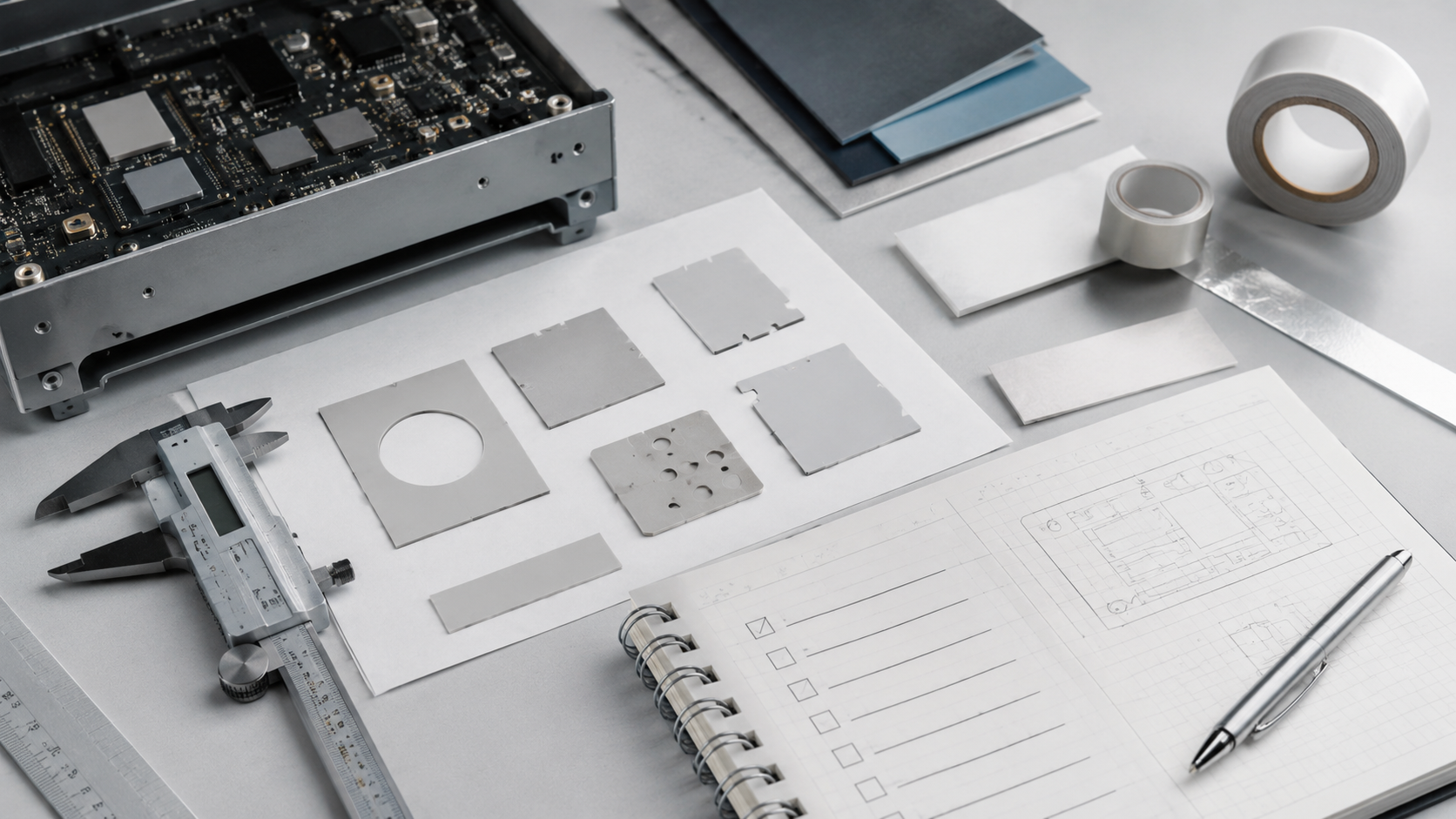
A reliable custom die cut thermal interface material should be designed around both thermal performance and manufacturability.
Before choosing a material, engineers should confirm the following information:
Design Item | What to Confirm |
Heat source | Chip, battery cell, power module, sensor, PCB or housing |
Heat path | Vertical transfer, lateral spreading or bonding transfer |
Gap size | Minimum gap, maximum gap and tolerance range |
Thickness | Material thickness after compression |
Compression | Pressure, compression ratio and contact stability |
Conductivity | Required thermal conductivity and thermal resistance |
Insulation | Dielectric strength and electrical safety |
Adhesive | Single-sided, double-sided or no adhesive |
Structure | Holes, slots, tabs, liners and lamination layers |
Production | Sheet format, roll format, inspection and packaging |
Information Needed for RFQ
For a faster and more accurate quotation, buyers should prepare drawings, material requirements, thickness, tolerance, application position, operating temperature, insulation needs, adhesive requirements and expected quantity.
If the project is complex, assembly photos, stack-up drawings or sample parts can also help the supplier provide better engineering suggestions.
Manufacturing and Assembly Details
Precision die cutting can add positioning holes, release liners, pull tabs, multilayer laminations, kiss-cut structures and roll-to-roll formats.
These details can improve assembly efficiency, reduce manual handling problems and support stable mass production.
For projects involving AI servers, EV batteries, telecom equipment and consumer electronics, custom die cutting also helps match different product structures and shorten the path from prototype to production.
Xinyusheng provides precision die cutting, lamination and custom converting services for thermal pads, graphite sheets, adhesive tapes, insulation materials and other functional components according to customer drawings and application requirements.
FAQ: Thermal Pads, Graphite Heat Spreaders and Thermal Tape
Is graphite better than a thermal pad?
Graphite is better for thin in-plane heat spreading, while a thermal pad is better for filling gaps and transferring heat through thickness. They solve different thermal problems, so one is not always better than the other.
Can thermal tape replace a thermal pad?
Thermal tape can replace a thermal pad only when the gap is very small and bonding is required. For larger gaps, uneven surfaces or compression needs, a thermal pad is usually more suitable.
What is the best material for AI server thermal management?
AI server thermal management often requires a combination of thermal pads, graphite heat spreaders, insulation films and adhesive components. The best choice depends on heat source, pressure, space, insulation and cooling structure.
What is the main advantage of a graphite heat spreader?
The main advantage of a graphite heat spreader is thin and efficient lateral heat spreading. It helps distribute localized hotspots across a larger area in compact electronic devices.
What should be checked before ordering custom die cut thermal pads?
Before ordering custom die cut thermal pads, engineers should check thickness, compression, conductivity, insulation, hardness, adhesive requirement, tolerance, liner design, drawing format and production quantity.
Conclusion
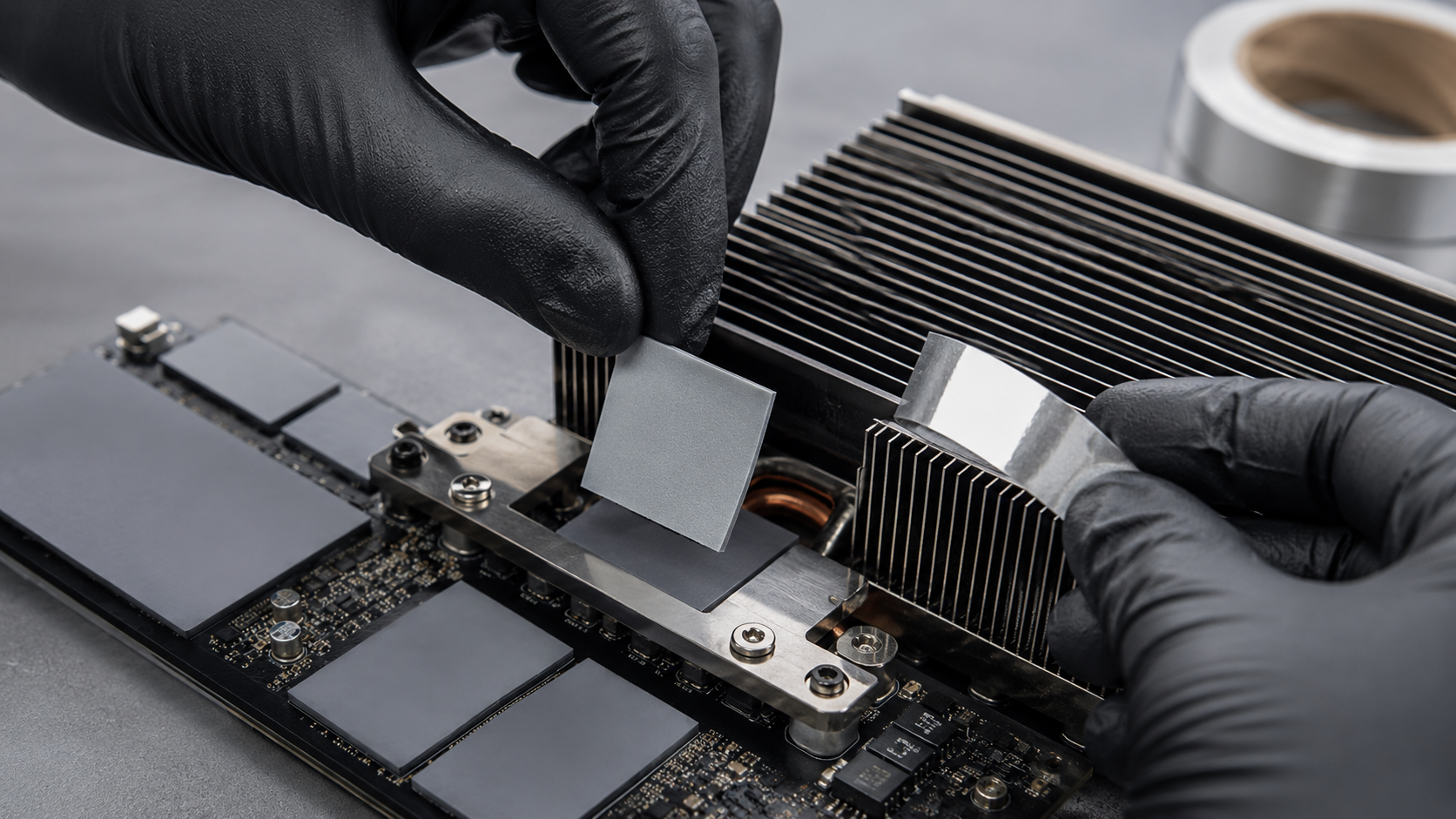
Thermal pads, graphite heat spreaders and thermal tapes are not interchangeable materials.
A thermal pad is suitable for gap filling and through-thickness heat transfer. A graphite heat spreader is suitable for thin lateral heat spreading. Thermal tape is suitable for bonding and moderate thermal transfer.
For AI servers, consumer electronics, EV batteries and telecom equipment, the most reliable solution is often a customized combination of materials. By matching the heat path, structure, insulation requirement and assembly process, engineers can choose the right die cut thermal interface material and improve both thermal performance and production reliability.
Table of Contents
Related news
Company News
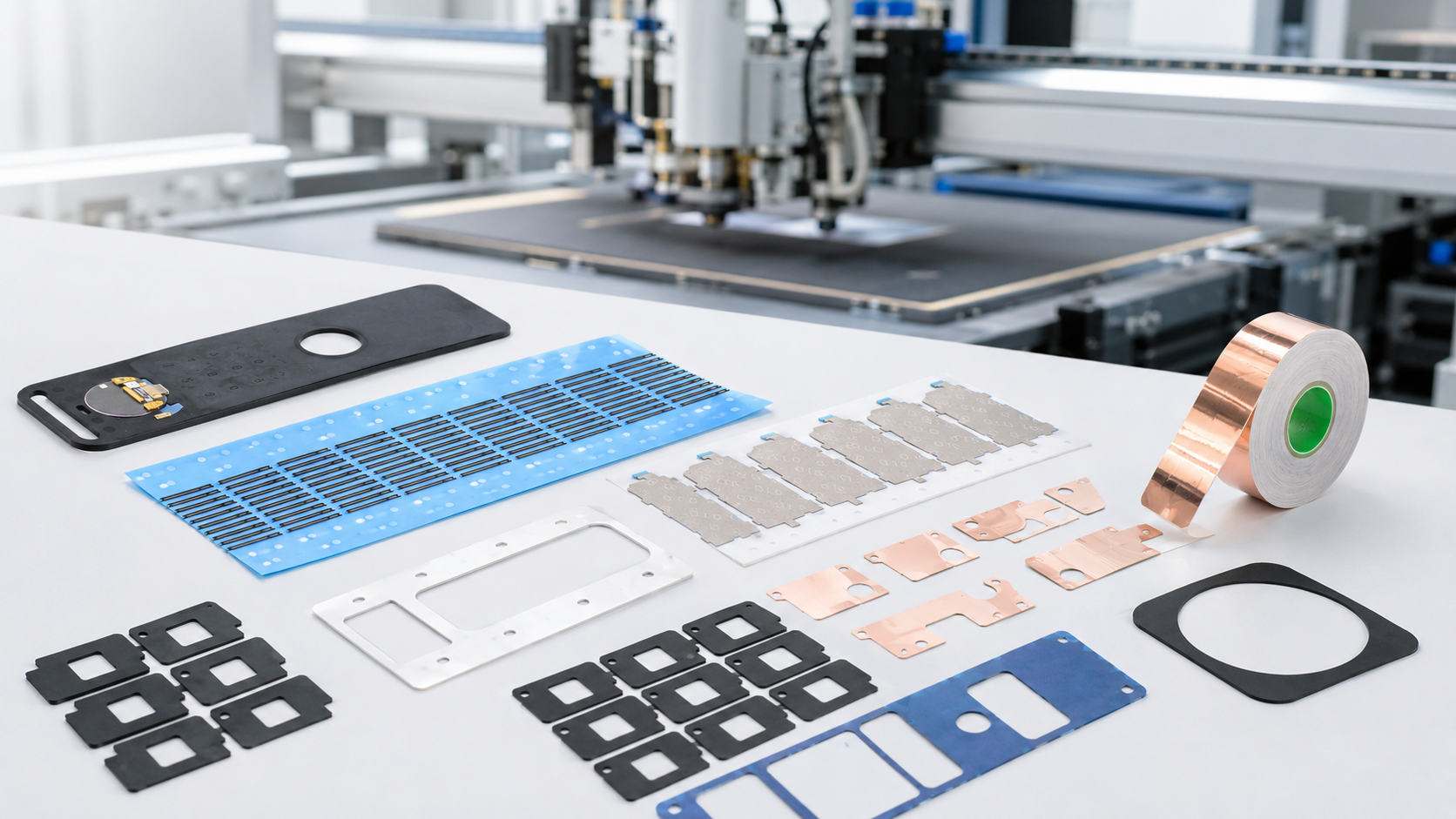
What Is Custom Precision Die Cutting? What Types of Custom Functional Components Is Xinyusheng Suitable For?
May 14,2026
Discover More
Company News
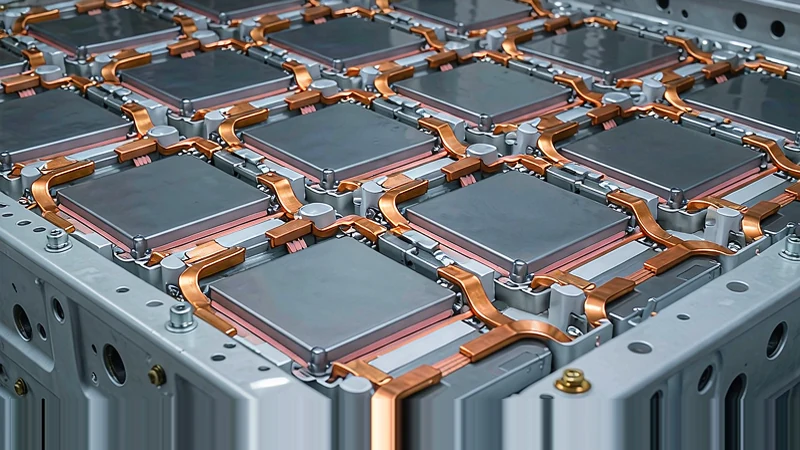
How Are Die Cut Materials Used in Automotive Electronics?
August 29,2026
Discover More
Company News
What Types of Thermal Interface Materials Can Be Die Cut?
August 29,2026
Discover More
